

The ClearAir® Air-to-Water Heat Pump
The ClearAir Air-to-Water Heat Pump From Cleaver-Brooks is now available through MPN Boilers in New York.
The ClearAir® AW0320 is Cleaver-Brooks' latest answer to commercial heating decarbonization. Built from the ground up for hydronic systems, it pulls heat from outdoor air and moves it into your building water - with no gas line, no combustion, and no onsite emissions. It's a real alternative to fossil-fuel boilers, not a workaround.
As your local authorized dealer, MPN Boilers can help you specify, size, and install the right heating and cooling system for your building - whether you're retrofitting an existing plant or starting fresh.
Local Law 97 and the ClearAir
If your building is over 25,000 square feet, you're already subject to New York City's Local Law 97 carbon emission caps and the penalty for missing your target is $268 per ton of CO₂ over the limit, every year.
Switching from a gas or oil boiler to the ClearAir eliminates onsite combustion entirely, which directly reduces your building's reported emissions. For many properties, a heat pump paired with existing boilers as a hybrid system is enough to bring a building into compliance or significantly reduce its exposure.
If you haven't run the numbers for your building yet, MPN can help contact us or visit our Local Law 97 page for more detail.
Contact MPN Boilers
Regarding ClearAir Air-to-Water Heat Pump in NY
The ClearAir® - What sets it apart:
- Zero combustion - no onsite CO₂, NOₓ, or CO emissions
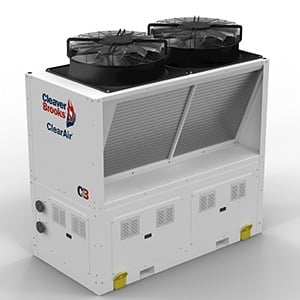
- High-temperature output up to 176°F (80°C) - works with existing hydronic equipment
- Factory-assembled, monobloc outdoor unit — no refrigerant work required on site
- R-513A low-GWP refrigerant, A1-rated (non-flammable, low toxicity)
- Built-in touchscreen controller for single units, multi-unit banks, or hybrid boiler systems
- Compact footprint - minimal disruption to your mechanical room
Just Doing Your Research? That's Fine Too.
If you're still early in the process - comparing options, reviewing budgets, or trying to understand whether a heat pump makes sense for your building - the ClearAir brochure is a good place to start. It covers performance specs, refrigerant details, installation notes, and application examples.

ClearAir® Air-to-Water Heat Pump
Engineered for Hydronic Systems - Not Borrowed from HVAC
Most heat pumps on the market were designed for comfort cooling and adapted for heating. The ClearAir wasn't. It was built specifically to serve commercial hydronic systems - delivering water temperatures high enough for coils, radiators, fan coil units, and terminal equipment already installed in your building. That means you can electrify your heating plant without ripping out everything downstream.
One Product, Multiple System Configurations
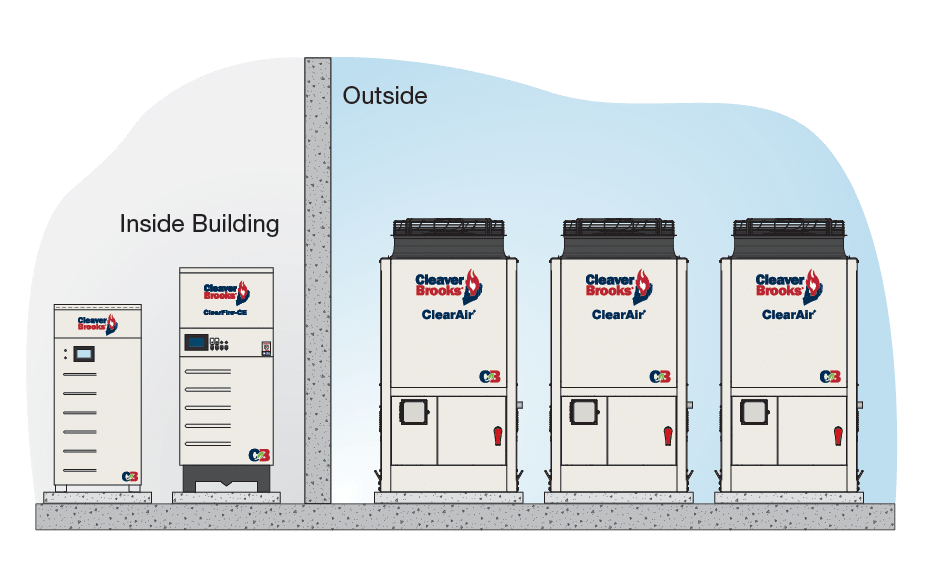
The ClearAir is designed to fit real project constraints not just ideal ones. Depending on what your building needs, you can deploy it three ways:
- A single unit handling a dedicated load or zone
- Multiple units running in parallel for larger buildings or redundancy requirements
- A hybrid setup alongside existing boilers letting the heat pump carry the base load while the boilers cover peak demand or cold-weather backup
That hybrid option is worth noting. It's often the most practical path for existing facilities, since it reduces emissions and operating costs without asking you to bet everything on a single technology in a cold climate.
Controls That Come Ready to Go
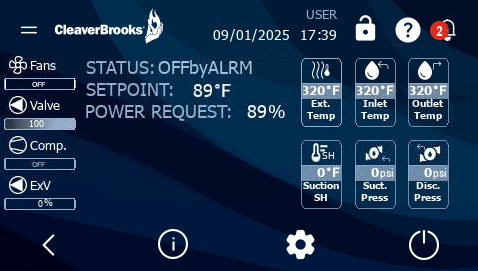
Every ClearAir unit ships with a factory-programmed controller nothing to configure from scratch. Out of the box it handles:
- Compressor and fan sequencing
- Electronic expansion valve management
- Hot gas bypass defrost cycle
- Lead-lag sequencing across multiple units
- Hybrid logic when paired with boilers
- BMS integration via BACnet or Modbus
It also connects to Cleaver-Brooks' Prometha® remote monitoring platform, so your team or ours can keep an eye on performance without being on site.
Why Heat Pumps Are Becoming Important and Essential
Heat Pumps Are Coming Up in Every Facilities Conversation Right Now And Here Are The 3 Key Reasons:
Emission targets are getting real
New York and other states have set binding targets on building emissions. Owners of large commercial properties are already getting letters about compliance timelines. Heat pumps are one of the most straightforward ways to make meaningful progress especially when the existing system is aging anyway.
Running costs over time
With a COP of 2.7, the ClearAir delivers well over two units of heat for every unit of electricity it uses. Compared to straight electric resistance heat or even gas at current prices that efficiency compounds across thousands of operating hours.
High-temp output changes what's possible in retrofits
The knock against heat pumps in older buildings has always been that they can't match the water temperatures existing equipment needs. At up to 176°F, the ClearAir answers that objection directly making electrification viable without a full system overhaul.
How Does an Air-to-Water Heat Pump Actually Work?
If you're new to the technology, this short explainer covers the vapor-compression cycle in plain terms no engineering degree required.
The Cleaver-Brooks Clear Air is an air-to-water heat pump that extracts heat energy from outdoor air and transfers it into a water circuit for heating purposes. It uses a refrigeration cycle to achieve this, even in cold ambient conditions.
The Core Refrigeration Cycle
The system circulates refrigerant through four key stages, using colour-coded lines to show the refrigerant's state at each point:
- Evaporator - Outdoor air is drawn across the evaporator coil. The cold, low-pressure refrigerant inside the coil absorbs heat from the air, causing it to evaporate into a vapour. Even cold air contains enough heat energy for this process.
- Compressor - The low-pressure vapour is drawn into the compressor via the suction line, where it is compressed into a high-pressure, high-temperature vapour and pushed out through the discharge line.
- Condenser / Heat Exchanger - The hot, high-pressure vapour passes through the condenser (the plate heat exchanger), where it releases its heat energy into the building's water circuit via the Water Inlet and Water Outlet connections. The refrigerant cools and condenses back into a liquid.
- Expansion Valve - The high-pressure liquid refrigerant passes through the expansion valve, dropping sharply in pressure and temperature before re-entering the evaporator and the cycle begins again.
Supporting components like the Oil Separator, Filter Drier, Receiver, Accumulator, and Suction Filter keep the system clean, protected, and running efficiently throughout the cycle.
Frost Buildup: A Natural Challenge
Because the evaporator coil operates at very low temperatures, moisture in the outdoor air naturally freezes onto the coil fins over time. As frost accumulates, it acts as an insulating layer that:
- Restricts airflow across the coil
- Reduces heat absorption efficiency
- Causes the system's performance to drop
This is a normal and expected condition in air-to-water heat pumps, particularly in cold or humid climates.
Defrost Mode: The Solution
To tackle frost buildup, the system enters an automatic Defrost Mode:
- A solenoid valve opens, redirecting hot high-pressure vapour refrigerant directly into the evaporator coil
- This hot gas defrost method melts the ice from the inside out quickly and efficiently
- Once the coil is clear, the solenoid valve closes again and the unit returns to Normal Operation
This is a smart, energy-efficient defrost approach it uses heat energy already present in the refrigerant cycle rather than relying on electric heating elements.
The Cleaver Brooks Clear Air heat pump works by continuously extracting free heat energy from outdoor air and delivering it as hot water for building heating systems. Its intelligent defrost cycle ensures it can operate reliably even in cold, frost-prone conditions making it a highly efficient, low-carbon alternative to traditional boilers.
A Refrigerant Designed for Where Regulations Are Heading
The ClearAir uses R-513A, an HFO-blend refrigerant with an A1 safety rating; meaning it's non-flammable and low toxicity. More importantly:
- Zero Ozone Depletion Potential
- Global Warming Potential of 573 compare that to R-134a at 1,430
- Already compliant with EPA 2025 refrigerant guidelines
Refrigerant regulations are tightening every few years. Specifying R-513A now means you're not going to be forced into a costly retrofit down the road because your refrigerant was phased out.

ClearAir Is a Good Fit For Building

The ClearAir is well-suited to any commercial or institutional building with an existing hydronic heating loop. The most common applications we see at MPN Boilers are:
- K-12 Schools and School Districts
- Medical Offices and Outpatient Facilities
- Commercial Office Buildings
- Colleges and Universities
- Multi-Family Residential Buildings
- Distributed Campuses and Healthcare Networks
- New Construction and Gut Renovations
Get In Touch With MPN Boilers Now.
MPN Boilers supplies the ClearAir® air-to-water heat pump from Cleaver-Brooks across New York. Zero onsite emissions, high-temperature hydronic heating up to 176°F a practical path to Local Law 97 compliance.
Get a quote today.
Enquire About ClearAir Air-to-Water Heat Pump in New York.
Ready to talk through your project? Call (914) 332-0099